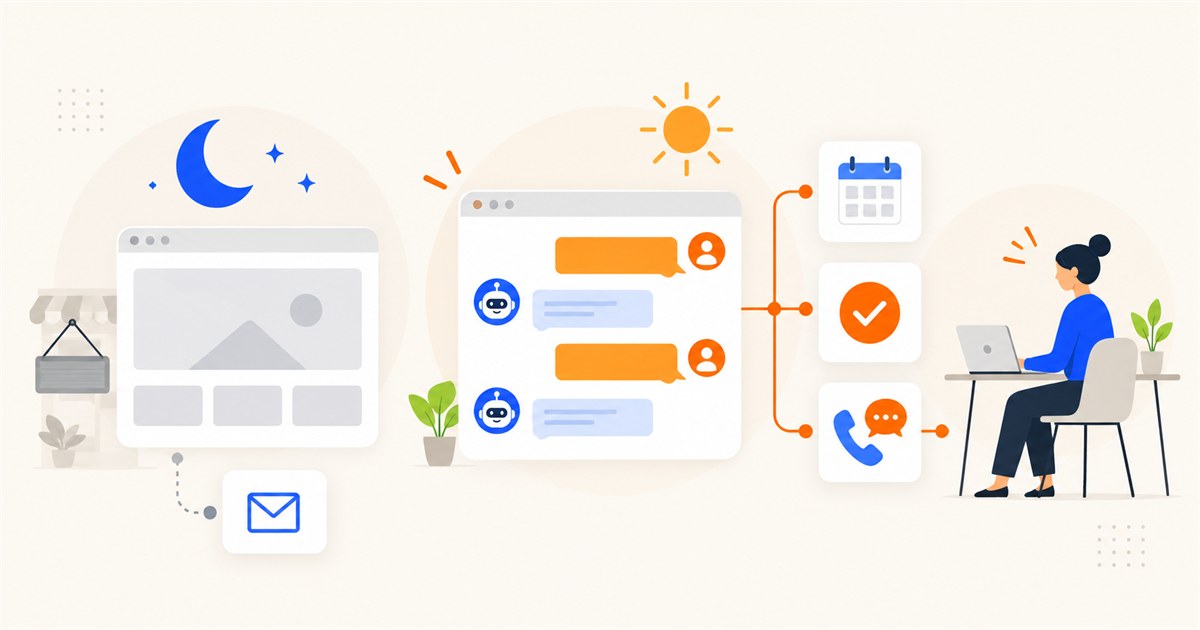
The short answer: a normal website shows your business. An AI-powered website also talks to the people visiting it. It answers their questions from your own information, asks the few questions that separate a serious buyer from someone browsing, books the next step, and hands the conversation to your team on WhatsApp or email with the details already filled in. For a Malaysian business that gets many enquiries after office hours or from a phone, that is the difference between a lead that waits until tomorrow and one that is looked after tonight.
What does a normal website do?
A normal website works like a brochure. It explains what you do, shows your photos and projects, and gives people a way to reach you: a contact form, a phone number or a WhatsApp button. Then it waits. The real work starts only when someone on your team sees the message and replies.
That is fine when enquiries are few and your team replies quickly. It starts to hurt when the same five questions come in every day, when enquiries arrive at 11pm, or when a customer who asked about prices on Saturday has already chosen someone else by Monday.
What does an AI-powered website add?
An AI-powered website keeps everything a normal website does, and adds an assistant that works inside it. A good one:
- Answers questions from your own content. Your services, the prices you choose to share, your outlets, opening hours and policies. In English, Bahasa Melayu or Chinese, depending on how the visitor writes.
- Qualifies the enquiry. It asks what you would ask: what they need, where they are, when they need it, sometimes their budget.
- Books the next step. A call, a site visit, an appointment or a quotation request, straight into your calendar or system.
- Hands over to a person. Your team receives the conversation on WhatsApp or email with the details already collected, instead of starting from "Hi, how much?"
- Works on WhatsApp too. Most Malaysian customers prefer to ask on WhatsApp, so the same assistant can answer there as well as on the site.
What stays the same?
The basics still matter. A slow, confusing website with an assistant on it is still a slow, confusing website. Clear pages, good photos, fast loading on a phone and a sensible structure for Google come first. The AI makes a good website work harder; it does not rescue a weak one.
Will the AI say something wrong about my business?
It can, if it is set up carelessly. The fix is boundaries. The assistant should answer only from content you have approved, follow rules you set (for example, never promise a delivery date or quote a custom price), and pass anything it is unsure about to a person instead of guessing. In the first month, someone on your team should read the conversations every week and correct the answers that were weak. After that, it needs much less attention.
Who needs one, and who does not?
An AI-powered website is usually worth it if:
- your team answers the same questions again and again;
- a good share of enquiries arrive after office hours or on weekends;
- you run ads, so every slow reply wastes money you already spent;
- your customers ask in more than one language;
- your business runs on appointments or bookings, such as clinics, fitness studios, education centres, services and property.
It can wait if you receive only a handful of enquiries a month, or if every sale comes through long, personal conversations that no assistant should be having for you.
How do you start without rebuilding everything?
- List the questions customers ask most. Twenty is plenty. Your sales or front-desk team already knows them.
- Decide what the AI may answer and what it must hand over. Opening hours, yes. A custom quotation, no.
- Connect it to where your team already works. WhatsApp, email or your CRM, so no enquiry sits in a separate inbox nobody checks.
- Start with one flow. Usually the enquiry or booking on your busiest page.
- Read the conversations every week and improve the answers. This is where most of the value comes from.
What should you ask a web developer before you hire them?
- Where does the AI get its answers, and can we edit them ourselves?
- What happens when it does not know the answer?
- Where do the enquiries land, and who on our team sees them first?
- Does it work on WhatsApp, or only on the website?
- Who owns the website, the content and the conversation data?
If the answers are vague, the assistant will be too.
How Stelix Tech builds them
At Stelix Tech we design and build AI-powered websites in-house in Kuala Lumpur, and connect them to the systems a team already uses. When the enquiries need somewhere to go, we build that too: a CRM, booking or customer portal with AI inside it. See AI-powered company systems, or tell us what your website needs to do.